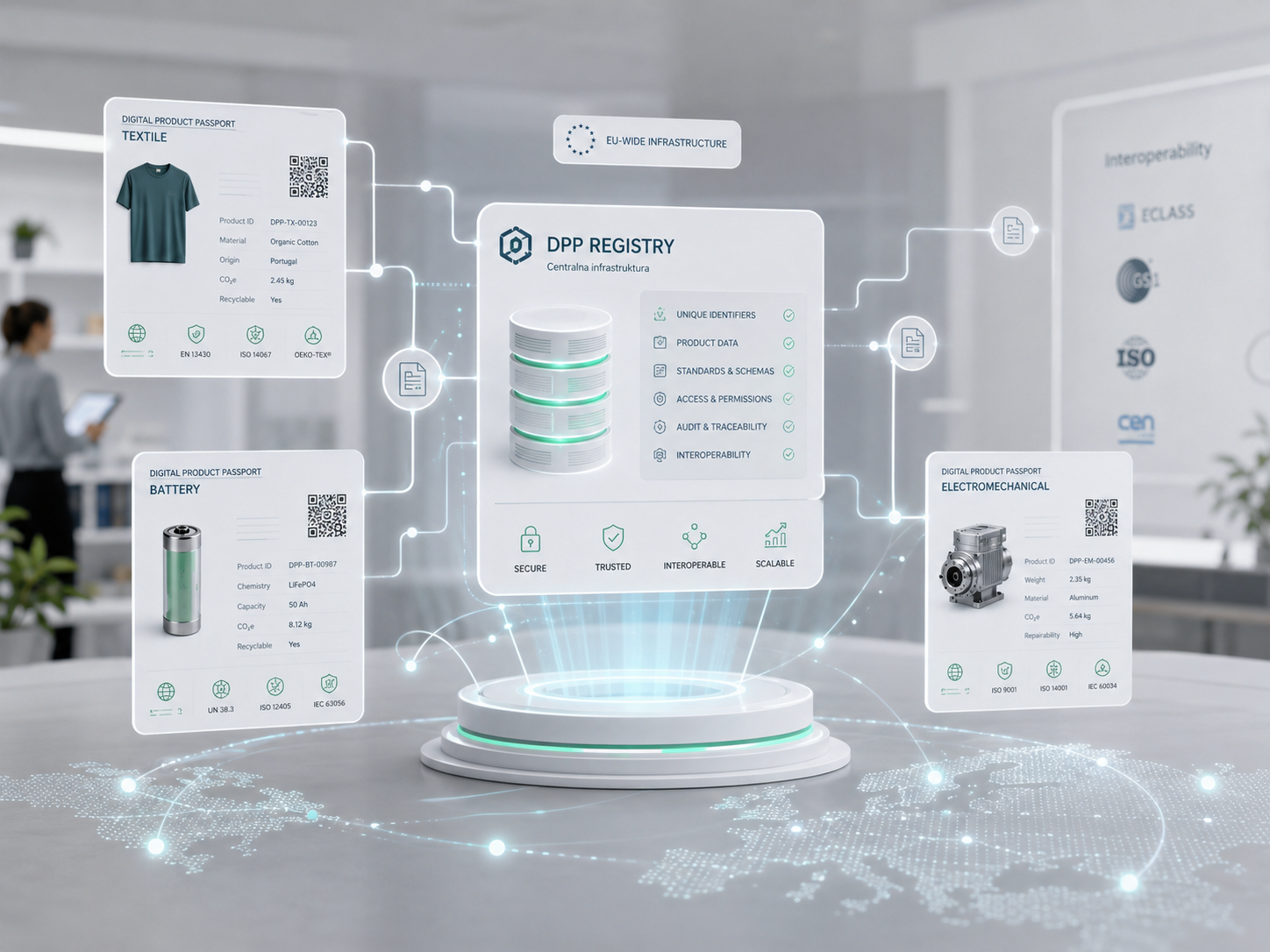

DPP and Artificial Intelligence: How AI Transforms Data Collection, Validation and Management
The Digital Product Passport (DPP) is becoming one of the key elements of Europe’s transition towards a circular and sustainable economy. However, as 2027 draws closer, many companies are facing the same challenge: how to ensure high-quality, accurate and standardised data at scale and in real time.
This is where Artificial Intelligence (AI) becomes a crucial technology. AI significantly accelerates DPP preparation, reduces the costs of data collection and enables a level of precision and automation that would be difficult to achieve without it.
This blog provides an overview of how AI is already transforming processes required for the DPP today, and how companies can use this technology as a real competitive advantage.
1. Automatic Data Collection and Extraction from Technical Documentation
The data required for a DPP are spread across different sources: technical datasheets, certificates, ERP systems and supplier documents. Manual collection is slow and prone to errors.
AI enables:
automatic text recognition from PDF documents
extraction of materials, components, dimensions and parameters
document classification and mapping of data to the DPP taxonomy
As a result, data preparation time is drastically reduced and accuracy increases.
2. Validation and Accuracy Checking Using AI-Based Error Detection
Regulatory compliance requires reliable data. AI models can detect:
missing or illogical values
contradictions between different data sources
incorrect units of measurement
misalignment with ESPR, CSRD or CSDDD requirements
AI flags anomalies before the data enter the DPP system, which reduces the risk of errors and improves overall data quality.
3. AI in Servicing and Predictive Maintenance
The DPP becomes particularly useful after the product has been sold. With AI, companies can:
predict failures based on usage history
automatically detect irregularities in product operation
optimise stock levels and management of spare parts
This reduces maintenance costs and extends product lifetime – fully aligned with the goals of the European circular economy.
4. Managing Large Volumes of Data Through Intelligent Systems
As the number of DPP obligations grows, so does data complexity.
AI supports this by enabling:
data standardisation
automatic tagging
identification of inconsistent records
preparation of data for delegated acts
This is particularly valuable for sectors with a large number of components: electronics, machinery, batteries and furniture.
5. How NOS Uses AI in DPP Preparation and Implementation
NOS combines consulting, methodology and AI technologies to enable companies to achieve:
faster data collection
automatic validation and error detection
integration of DPP systems with ERP
long-term regulatory compliance
Our approach allows companies to fully prepare for the DPP and to establish a stable data management system throughout the entire product lifecycle.
Conclusion: AI as a Catalyst for DPP Transformation
The Digital Product Passport is becoming a key tool for transparency, circularity and sustainability in the European Union.
Without Artificial Intelligence, the process of collecting and managing data for the DPP would be slow, expensive and prone to errors.
AI enables:
faster data preparation
reduction of errors and risks
predictive product management
scalable, long-term solutions
Companies that combine DPP and AI will have a clear advantage – they will be able to react quickly, ensure high-quality data and become more competitive on the market.
For consultation and more information on preparing and implementing Digital Product Passports, feel free to contact us at info@nos.hr.